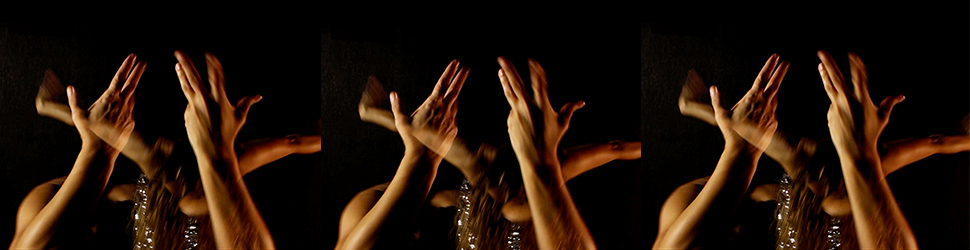
Threads of Time
My artistic practice explores the body as a living archive and as an essential vehicle for connecting with the physical world. I understand the body as a space where emotions, memories, thoughts, and unconscious experiences converge, shaping identities that are unique and constantly transforming.
In a society marked by speed and by an increasing separation between mind and body, my work functions as an act of resistance and reconnection. Through performance, video, photography, installation, and new media, I create spaces where the body can recover its voice, presence, and temporality. My work invites viewers to slow down and reconsider how they perceive themselves, others, and the environments they inhabit.
Movement is central to my practice. It emerges not only through visible actions but also through micro-gestures, breathing, tension, repetition, displacement, flexion, and stillness. These physical elements become a visual and temporal language that extends into space and communicates beyond words.
My creative process integrates conscious movement with objects, materials, architecture, images, and audience interaction. Each element contributes to an interconnected system in which the body becomes both subject and medium. My background in visual arts and contemporary dance allows me to approach performance from a multidisciplinary, embodied perspective.
Through this practice, I investigate memory, migration, identity, transformation, and the relationship between body and territory. I seek to create sensory experiences that challenge mind-body dualism and reveal the body as a site of knowledge, resistance, vulnerability, and connection.
Relative Abstraction (Performance)
Elastic bands and human anatomy converge in a spatial poetics of encounters, intersections, connections, tensions, and approximations, managed through a hierarchical play taken to its limits. The eponymous performance inspires the photographic series of the relative abstraction project. It captures the postures and positions derived from the five magical passes described in the “Purple Book” by anthropologist Carlos Castaneda.
The five magical passes, teachings handed down by Don Juan, the last heir of the Toltec shamanic tradition, were transmitted to Carlos Castaneda. These movements are designed to help individuals rediscover mental, physical, and spiritual balance by redistributing energy throughout the body and revitalizing what Don Juan referred to as the Toroid, or energetic aura, an omnipresent yet little-understood entity.
In this series, Castaneda employs the concept of “Tensogravity” to describe the dynamics of the magical passes and the tension and equilibrium generated between the body and the elastic bands. These bands symbolize the tension in the tendons resulting from the connection between bone and muscle, thereby articulating the biomechanics of the bodily structure.
Vertebrates
The work initiates a profoundly evocative graphic journey, wherein the artist narrates her experience in therapeutic sessions provided to her patients, focusing on bodily alignments. Through meticulous observation of hundreds of bodies communicating through their posture, an unceasing quest is undertaken to achieve neutrality, equilibrium, and optimal functionality.
The experience of pain, tension, relief, and the discovery of a new, inherent yet unconscious physical spatiality intertwine in this visual narrative. Each recognition of alignment is directly imprinted in the footprint and the varying pressures exerted on the support. The footprint, as the point of weight discharge, offers profound insights into the individual’s physical and psychological dimensions.
Equilibrium, far from being static and permanent, is a constant state of balancing opposing forces that compensate and nullify each other to achieve stability. This reflection invites us to draw an analogy with the broader meaning of life, where the pursuit of balance becomes an essential metaphor.


